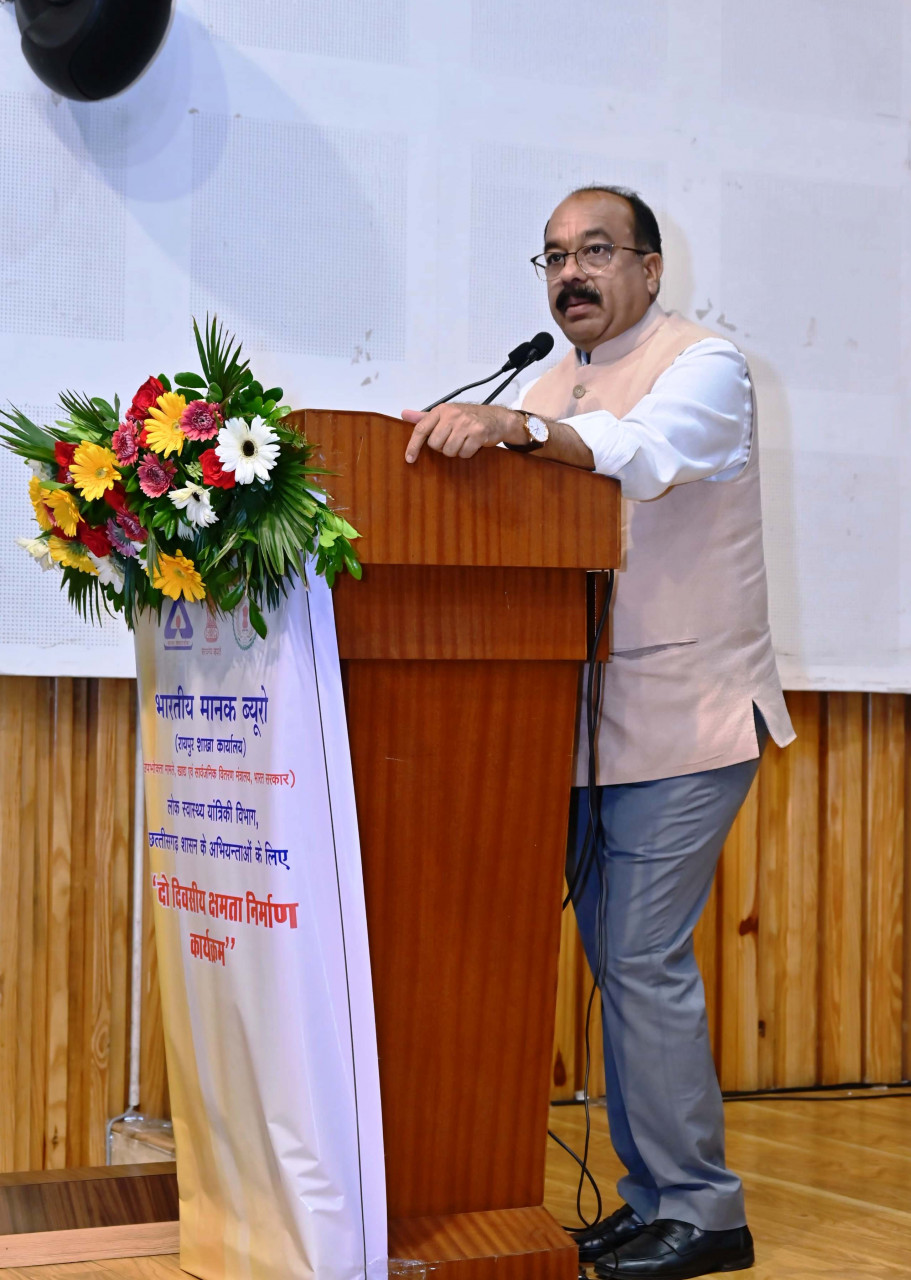
Deputy Chief Minister attended the capacity building program organized by BIS for PHE engineers
Experts from across the country are providing information about the new standards of materials and works used in water supply schemes
Raipur, 21 July 2025


Deputy Chief Minister and Public Health Engineering Minister Shri Arun Saw today participated in the capacity building program organized by the Bureau of Indian Standards for the engineers of the Public Health Engineering Department. This two-day program has been organized by the Raipur office of the Bureau of Indian Standards on July 21 and July 22 at the Naveen Vishram Bhavan in Raipur. Subject experts from across the country are giving information to PHE engineers about the new standards of materials and works used in water supply schemes. More than 120 engineers of the Public Health Engineering Department from across the state are participating in it, including Chief Engineer to Superintending Engineer, Executive Engineer and Assistant Engineer.
Addressing the capacity building program, Deputy Chief Minister Shri Arun Saw told the engineers that it is important to stay updated with new standards and innovations in the fast-changing world. As an engineer, knowledge of contemporary technical aspects and their new parameters is essential. Good knowledge of these is very helpful in completing the work with quality. He thanked the Bureau of Indian Standards for organizing the capacity building program and said that this will increase the efficiency and capability of our engineers.
Deputy Chief Minister Mr. Saw said that the work of the Public Health Engineering Department is directly linked to public welfare. Whether it is the provision of clean drinking water, the process of water purification or strengthening the water supply system in rural and urban areas. The effectiveness of these works depends on how much we follow the standards and how successfully we implement technical knowledge on the ground. He expressed hope that this program will be helpful for the engineers of the Public Health Engineering Department in performing effective work at their workplace.
Secretary of Public Health Engineering Department, Mr. Mohammad Qaiser Abdulhaq said that this program has been organized by the Bureau of Indian Standards to make the engineers of the department aware of the standards and parameters prevalent in the country and the world. He appealed to the departmental engineers to adopt the things learned here in the measurement and evaluation of the works in the field. Director of Jal Jeevan Mission, Mr. Jitendra Shukla, Chief Engineer of Public Health Engineering Department, Mr. T.D. Sandilya and Regional Director of Bureau of Indian Standards, Mr. S.K. Gupta also addressed the participating engineers.
Information related to these standards will be provided in the two-day capacity building program
The experts from BIS will provide information to PHE engineers in the two day capacity building programme on Best Practices for Water Supply, Drainage and Sanitation for Enhancing Building Utility, Optimization of Services and Resources: Drinking Water Supply Services and Asset Management Systems, Role of Standards in Ensuring Availability of Safe Water, Quality of Drinking Water, Sampling and Testing, Sustainable Harvesting: Role of BIS Standards in Rain Water Management, Modern Sanitation Solutions: Rotational Moulded Polyethylene Septic Tanks and IS 18666, Overhead Tanks, Civil Structures (Metal, Cement, RCC), Packaged Water Treatment Plants (Conventional & Unconventional), Optimization of Efficiency: Asset Management in Waste Water Supply Networks, Achieving Excellence through Standardization in Pipe Materials (DI/CI/PVC/HDPE) and Pumping Systems.
These experts of BIS are giving information
As resource persons, experts from Bureau of Indian Standards namely Mr. Falendra Kumar, Rajesh Kumar Das, Devendra Singh Dhapola, R.P. Dewangan, Dr. N. Murali Mohan and Dr. Mayur J. Kapadia are providing information about new standards and parameters related to water supply system and rain water harvesting to the engineers of Public Health Engineering Department