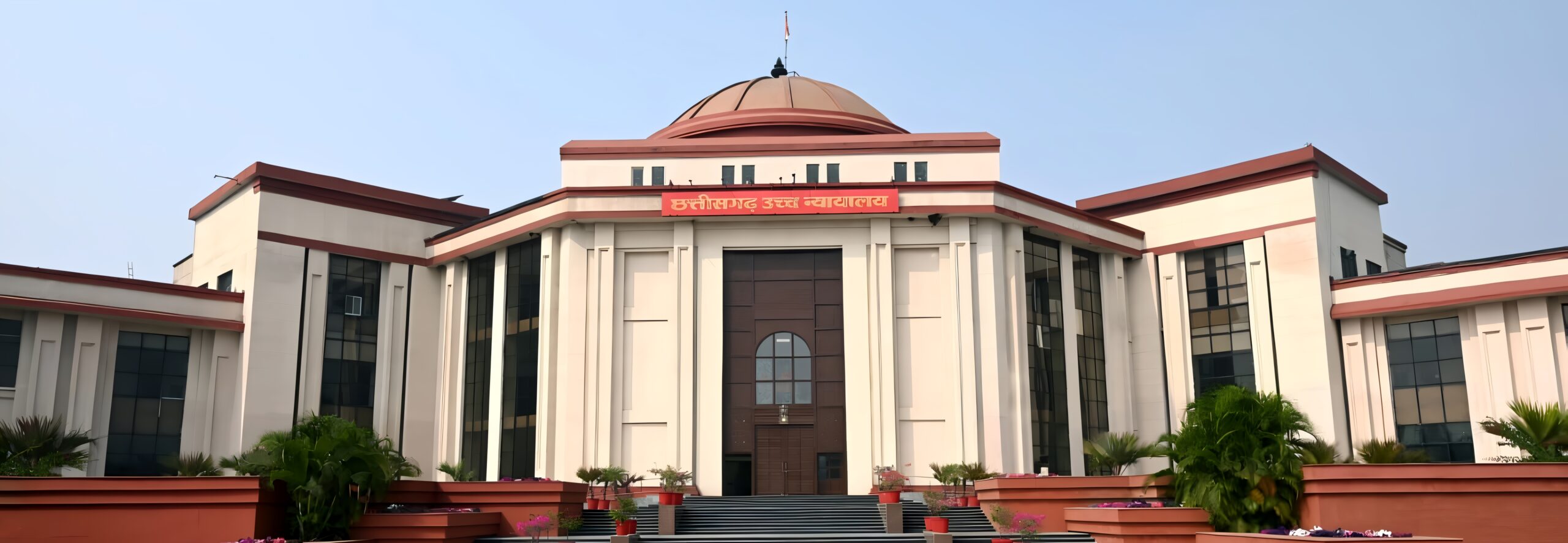
Bilaspur. An unprecedented situation has arisen in the Chhattisgarh High Court, where, during the hearing of a case, a judge not only recused himself due to family ties but also directly challenged a circular issued by the Chief Justice (CJ). A Division Bench comprising Justice Sanjay S. Agrawal and Justice Narendra Kumar Vyas clearly signaled that interference in judicial autonomy, under the guise of administrative orders, would not be tolerated.
**Niece as Counsel, Uncle as Judge: Case Recused for the Sake of Propriety**
The matter came to a head when Justice Sanjay S. Agrawal’s court heard a case in which his own niece—Advocate Shivangi Agrawal—appeared as a junior to a senior counsel. Although she had appeared in this case previously, this time the Division Bench turned it into an ethical issue, citing “professional conduct and decorum.” The Court emphatically stated that fairness must not merely exist; it must also be seen to exist. Citing a lengthy list of precedents, the judges clarified that close relatives should not even appear before the bench of the concerned judge, ensuring that no aspersions can be cast upon the purity of justice.
**Judges Strike Back at ‘Bench Hunting’ Circular: “This is Interference!”**
The real bombshell dropped when the Division Bench launched a ‘surgical strike’ against a circular issued by the Chief Justice on April 16—a circular ostensibly introduced to curb so-called “bench hunting.” This circular contained strict directives regarding the relationships between lawyers and judges, and mandated that judges provide ‘written reasons’ in certain instances.
Registering strong objection to this, the Division Bench termed it a direct interference in the functioning of the Court. In scathing terms, the judges observed:
“It is the sole prerogative of the concerned Bench to decide when an exception is to be made and how the proceedings are to be conducted. It is not appropriate to fetter judicial discretion through administrative circulars.” A Standoff: The Ball is Now in the Chief Justice’s Court
The judges not only recused themselves from hearing the case but also directed that the entire dispute be referred to the Chief Justice. This order conveys a clear message: a line has been drawn within the High Court between ‘administrative orders’ and ‘judicial independence.’
It now remains to be seen what stance the Chief Justice adopts regarding this “judicial objection.” Will the efforts to curb ‘bench hunting’ yield results, or will this firm stance taken by the judges lead to a reshaping of the circular’s framework?